
The most valuable vintage Smurfs are not the ones most people pull out of a shoebox. Schleich and its licensees sold more than 300 million PVC Smurf figures across roughly 400 poses, so an ordinary 1980s figure sits at the bottom of the market however old it is. The pieces that consistently top sold prices fall into a few categories: prototypes that never went on sale, club editions with numbered certificates, early Bully castings, one-market promotional variants, and Super Smurfs that still have their box and accessories. Dated ranges for individual figures appear in the documented-figures table on this page as each is checked, following our price method.
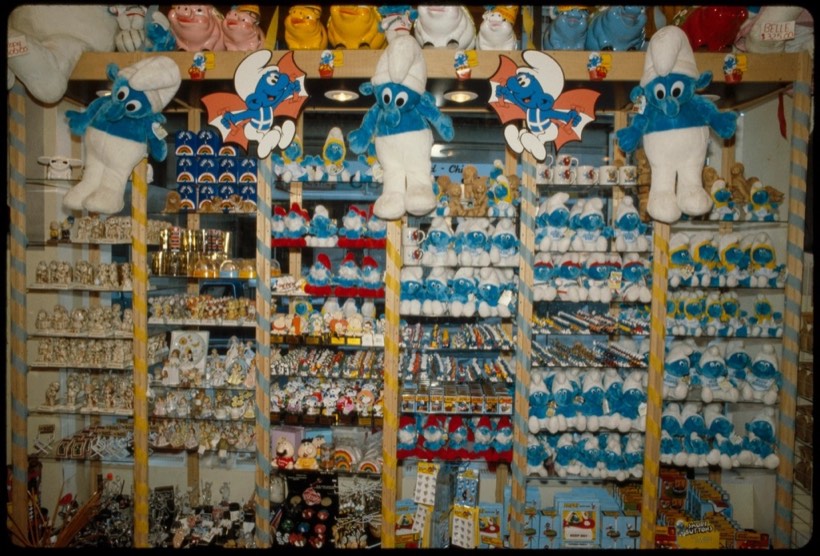
Which vintage Smurfs sell for the most?
Ranked by how high their single-figure sales usually run, these are the categories that keep appearing at the top. The tiers are relative, not price brackets. Figure-by-figure notes on the scarcest pieces are on our rare Smurfs guide; this table is about types.
| Tier | Category | Era | Why it sells high | |
|---|---|---|---|---|
| 1 | Prototypes and unreleased colorways | Late 1970s to mid-1980s | Never sold at retail; known from catalogs and a few collector-held examples | |
 | ||||
| 1 | Smurf Collectors Club International editions | 1988 to 2001 | Editions of 100 to 350 with numbered, seal-embossed certificates | |
| 2 | Early Bully castings and one-piece molds | 1970s | Short license, soft hand-painted PVC, molds changed within a season | |
| 2 | One-market promotional colorways (UK early colors, rugby kits, BP Australia navy) | 1977 to 1982 | Sold in one country for one promotion; scarce everywhere else | |
| 2 | Complete boxed Super Smurfs and playset-only figures | 1978 onward | Boxes were thrown away; without its accessory a Super Smurf is a regular figure | |
| 3 | Short-run paint variants (Chef with red sauce, early color states) | 1978 to 1979 | Painted for a year or two, then replaced | |
| 3 | Jubilee set in its package, Karstadt blisters | 1984 to 1985 | Limited retail runs; packaging rarely survived | |
| 4 | Standard regular figures in common paint | 1978 to 1989 and re-runs | Made in the hundreds of millions; condition is the only lever | |

Why prototypes and club figures top the list


A prototype beats everything else because supply is close to zero and the story is provable. The Field Hockey colorway shown only in the 1981 Wallace Berrie catalog, and the Christmas prototypes covered on the rare Smurfs page, were never sold, so every example that surfaces competes for the same small group of advanced collectors. Blue Buddies' top-five list of rare figures is built the same way, from the Praying Smurf and Smurfette to the Christmas Candy Cane and Wreath Smurfs.
Club figures are the other sure thing, because their scarcity is documented. The Smurf Collectors Club International ran until spring 2001 and had six figures made by Schleich, each sold with a numbered certificate embossed with the club seal. Editions ran from 100 for the Smurf with Elephant of 1988 to 350 for the second Gold Pig, with 250 for the Smurf with Dove and for a 10th Anniversary Super Smurf built on the 40224 Teacher Papa. The certificate is what you are paying for; a standard figure with a Schleich animal glued into its hand is worth nothing extra.
Early Bully and the first Schleich castings

Bully made Smurfs through the 1970s, starting with a Kellogg's promotion, and lost the license in 1980. Its early figures are soft, hand-painted PVC, and a few changed within months of release: the 2nd Tennis Player of 1977 was first cast with the racket as part of the figure, and that one-piece version sold only briefly before the racket became a separate part. Across the era, the earliest casting of a pose outsells every later one. A figure with Peyo on the arm and nothing on the feet is the earliest Schleich state, and because fakes are unmarked too, the matte hand-applied paint is what confirms it.
One-market promotional releases
Promotional Smurfs are scarce by design: a company orders a fixed run, usually a standard mold with a changed paint job or a swapped object, and the figures never reach the regular catalog.

- UK National Garages, 1977 to 1982. A pilot at seven London stations ran from November 1977, the national launch came on 20 May 1978, and the last figures in BP boxes were sold in November 1982. Early color states replaced within a year, the rugby team kits and the withdrawn Saver Smurf of late 1978 all come from this run.
- BP Australia, 1980 to 1982. The navy-top Australian Rules Smurf on its green oval base often turns up without the base, and sellers still ask a premium for the figure alone.
- Detergent and food premiums. OMO washing powder packed one-inch blue mini Smurfs marked "OMO Peyo 1983", INA gave away six solid-blue figures the same year, and McDonald's ran ten-figure sets in Germany and the Netherlands in 1996 and in the UK, Ireland and Iceland in 1998, each with an M on the back of the head.
Boxed Super Smurfs, playsets and sealed examples
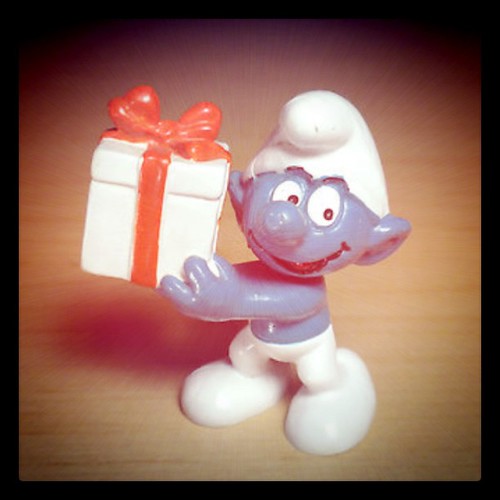
Super Smurfs were the first Smurfs sold in a box, with a separate accessory such as a vehicle or furniture. Blue Buddies dates the first three, the Bobsled, Chimney Sweep and Tricycle Smurfs numbered 40201 to 40203, to 1978. The box and the accessory are the whole premium: collectors on that forum describe throwing boxes away as children and hunting boxed examples decades later, and smurfs.com.au notes that a Super Smurf separated from its accessory is routinely sold as the ordinary regular figure.

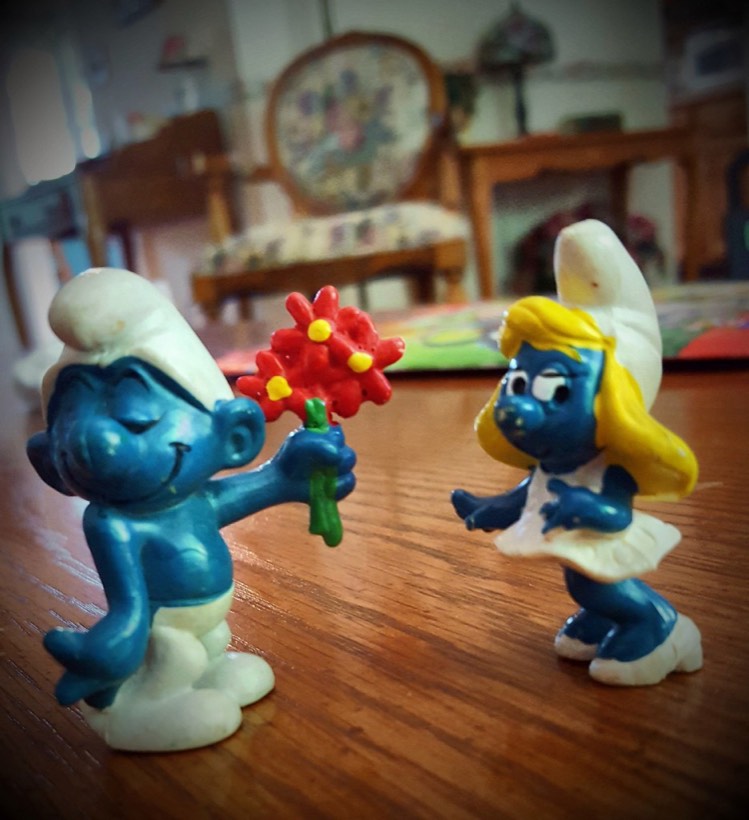
Playsets add a second premium: figures made only for the set. Schleich's Smurfette's Bedroom came with a seated Smurfette powdering her nose that was never sold alone, while the Applause version used the regular 20182 nightgown Smurfette. Sealed retail packaging is the last layer. Karstadt commissioned yellow blister packs from Schleich in 1984, the arrangement ended after twelve figures, and the blisters are scarcer than the figures inside. The Jubilee Smurfs, nineteen figures for the 1965 to 1985 anniversary with the year stamped in gold on the back of the head, are collectible loose but far more so in the light-blue shrink-wrapped package, partly because the gold rubs off.
What drives the value of a vintage Smurf
Seven factors decide where a figure lands, and they stack: a rare variant in poor condition can sell below a clean common figure.
| Driver | Raises the price when | Lowers it when | |
|---|---|---|---|
| Rarity | Prototype, one-market promo, short first casting or numbered edition | "Rare" is only in the listing title | |
| Condition | Mint: no rubs, fading, paint flaws or missing parts | Any wear; Blue Buddies counts even a tiny scratch as not mint | |
 | |||
| Completeness | Every accessory, base or held object is present and original | The accessory is lost; the figure drops to the regular tier | |
| Box or package | An early Schleich, National or Applause box, a Karstadt blister or a Jubilee package survives | The packaging is a common later design | |
| Paint variant | The variant color shows the same wear and gloss as the rest of the figure | The "variant" is sun fading, a repaint or a batch hue difference | |
| Provenance | A club certificate, catalog photograph or documented collection backs the claim | Only the seller's description does | |
| Timing and venue | Motivated buyers are active; Christmas figures sell best in season | The figure is buried in a lot or sold where it is common | |
The year on the foot is missing from that list because it is not a value driver. It is the first year of the mold, so a figure stamped 1978 may have been poured at any point over the following decades. Our vintage Smurf figures guide explains how to date a figure from its country mark and paint dot instead.
Rare is not the same as valuable
Rarity is fixed; value is not. Blue Buddies, which rates every figure on a five-Smurfberry rarity scale, answered a seller who found its "very rare" figures selling cheaply with exactly that: a figure is worth what one buyer will pay on the day, and the market moves with the economy, the season and the trend of the moment.
Three examples. The 1996 McDonald's 25th Anniversary Smurf is called rare by an American site and was a free premium across Germany and the Netherlands; likewise the US administrator of the Blue Cavern forum described the early UK color variations as rare in America but common in Britain, so one figure can sit in different tiers on the US and UK sites. The Rugby Smurf team kits are among the figures Blue Buddies calls most sought after, yet Blue Imps found their prices "varied incredibly." And the two most-searched characters, Smurfette and Papa Smurf, have standard 1980s figures as common as any other, so those sit in the lowest tier; only a confirmed early paint state or a playset-only Smurfette climbs.
Myths about Smurfs worth a fortune
- "Every 1980s Smurf is valuable." More than 300 million were sold, the cartoon years produced the largest runs, and age alone moves nothing.
- "It says 1978, so it was made in 1978." The molded year is the mold's first year. Schleich assigned article numbers when sales began, separately from the mold year, which is why a figure can carry a 1970s date and a much later marking.
- "A big lot proves what each figure is worth." Lots sell for the lot. A thirty-figure bundle says nothing about a single variant.
- "The price guide says so." Printed guides such as Jan Lindenberger's Smurf Collectibles handbook record a market from decades ago, and Blue Imps notes that most were produced by dealers. Online estimators show asking prices, not sales.
- "Rare in the title means rare." It means the seller typed the word. Rarity belongs to the exact variant, confirmed from stamp and paint, never to the listing.
How to check a real sold price yourself
Asking prices are wishes. The only number that matters is what a buyer paid for the same variant in the same condition, and it is free to find on eBay once you filter for it.
- Identify the figure first: catalog number, maker mark, country mark, dot and paint state. Search by number and name together.
- Filter to sold and completed listings and ignore everything still for sale.
- Exclude lots, mixed bundles and sales closed with an accepted best offer, where the real figure is hidden.
- Open each sale and check the photographs of the feet and the variant detail. No stamp photo, no proof.
- Repeat on the UK site for anything with a National, BP or rugby connection.
That is the short version of the price method behind every range on this site. The Schleich Smurfs guide explains the numbering you will search by, and the character index helps when you have a figure but not a name.
UK note: National Garages, BP and the yellow Smurfs
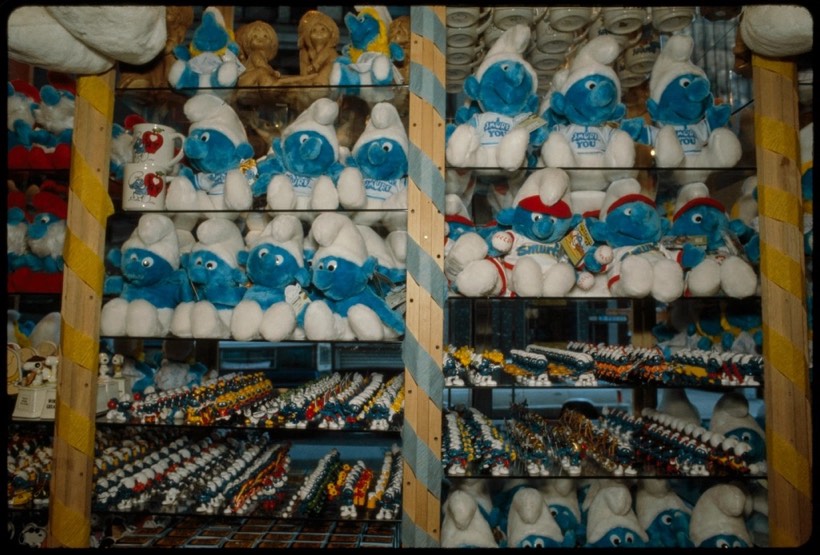
National put ten figures, the large house in a UK box and the garden playset on sale on launch day in 1978, and had about forty figures out by early 1980. Late 1978 brought yellow-scarf versions of the Chimney and Sledder Smurfs, and Brainy with yellow glasses was first shown in summer 1979; both are early UK color states that were later replaced. The yellow paint dot is a separate matter. Blue Buddies ties it to the Portuguese painting facility that opened in Oporto in the early 1980s, while Blue Cavern collectors who sorted a 1979 National lot distinguish a mustard dot from a brighter true yellow and suspect the yellow ones were painted in Germany. Neither theory is settled. What is settled is that these variations are common in Britain and scarce in America, so a UK-sourced figure is often worth more to a US buyer than to a British one.
Documented figures and values
Sources
- https://en.wikipedia.org/wiki/The_Smurfs_merchandising
- https://blueimps.com/smurf_faq.html
- https://blueimps.com/smurf_markings.html
- https://www.blueimps.com/smurfs_news13.html
- https://bluebuddies.com/smurf_figurines/what_is_my_smurf_worth.htm
- https://bluebuddies.com/smurf_figurines/smurf_figurine_basics.htm
- https://bluebuddies.com/smurf_figurines/smurf_paint_dots.htm
- https://bluebuddies.com/smurf_figurines/wallace_berrie_smurfs.htm
- https://bluebuddies.com/Smurfs_SCCI_Smurfs.htm
- https://bluebuddies.com/Smurfs_Jubilee_Smurfs.htm
- https://bluebuddies.com/Smurfs_Promo_Smurfs-70.htm
- https://bluebuddies.com/Smurfs_OMO_Smurfs.htm
- https://bluebuddies.com/Smurfs_McDonalds_Smurfs.htm
- https://bluebuddies.com/Smurfs_Super_Smurfs.htm
- https://bluebuddies.com/Smurfs_Smurf_Playsets-4.htm
- https://bluebuddies.com/cgi-bin/ultimatebb.cgi/topic/1/1615.html
- https://www.smurfs.com.au/category/smurf-figures/
- https://www.thecursedcountry.com/Nationalbenzole.html
- https://forum.bluecavern.com/viewtopic.php?p=185303
- https://forum.bluecavern.com/viewtopic.php?p=175174
- https://forum.bluecavern.com/viewtopic.php?p=161631
- https://www.worldcollectorsnet.com/?p=17807
- https://schifferbooks.com/products/smurf-collectibles
- https://company-histories.com/Applause-Inc-Company-History.html
Editorial draft · Last reviewed 2026-11-04