
Vintage Smurf figures, which many collectors call vintage Smurf figurines, are the solid PVC Smurfs made between Schleich's first release in 1965 and the end of West German production around 1990, and nearly all of them can be dated from the marks molded into the plastic. This guide goes deeper than the stamp basics on our Smurf figures hub: six identification checks, a table of maker and country marks by period, the dot system, originals versus later runs of the same mold, Super Smurfs, fakes and grading. Value is discussed in relative terms; sold ranges live in the figure checklist and follow the price method page.
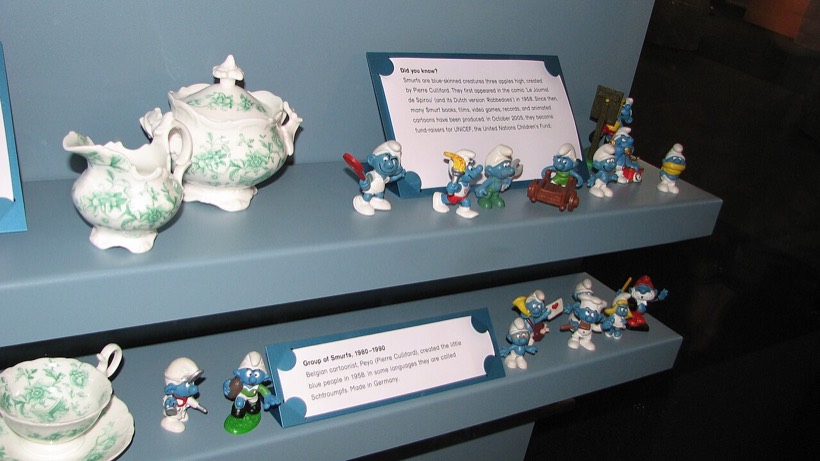

What counts as a vintage Smurf figure?
This page draws the line at the production history. The publisher Dupuis had the first figurines made in 1959, and Schleich began the mass-produced PVC line in 1965. Schleich made no Smurfs from 1972 until 1977; in that gap the rival firm Bully of Spraitbach made its own figures from 1973 until 1980 under a German license. After the restart a contract factory in Hong Kong cast figures for non-European markets from 1978, Portuguese paint shops took on much of the European painting from about 1979, and a Sri Lankan factory opened around 1982. Demand collapsed after 1985, the Hong Kong factory closed that year, and by 1990 reunification had turned "W. Germany" into "Germany" on the molds. So a figure stamped W. Germany, Bully, Hong Kong, Portugal, Sri Lanka or Macau is a candidate for vintage, while Germany or China means later production even when the pose is a 1970s design. These dates come from collector research, not a company archive, so allow a year either way.
How to identify a vintage Smurf figure: six checks

Work through these in order under a lamp.
- Find the mark. Check the soles, then the backs of the legs and the upper arms. The earliest Schleich castings carry "Peyo" on an arm and nothing on the feet, so blank soles do not by themselves mean a fake.
- Name the maker. Schleich used a round stick-figure emblem before it moved to the spelled-out name with an "S". "Bully" with "West Germany" is the rival maker. "W. Berrie Co.", "W.B. Co." or "Applause" beside Schleich means a Hong Kong casting for American distribution.
- Read the country. The table below gives each country's working period. The country mark records where the figure was cast and the dot where it was painted; the two often differ.
- Read the year and the small digit. The year is the mold's first year. Years were only added to Schleich molds around 1979 to 1980, so a 1970s pose with no year can be older than the same pose with one. The single digit from 1 to 8 is the cavity position in the injection machine and says nothing about age.
- Check the sole for a dot. A colored dot means the figure passed quality control after the 1978 lead-paint scare; the color names the paint shop.
- Compare paint and accessories last. Only now set the colors and accessory against the documented variants of that mold number. The figure checklist on this page shows the stamp beside each photographed example.
Smurf maker and country marks by period

The periods below were reconstructed by collectors from dated catalogs and marked examples.
| Mark on the figure | Period | What it tells you | |
|---|---|---|---|
| "Peyo" on the arm, feet blank | Late 1960s to 1972 | The original Schleich production; Papa Smurf 20001 was first issued this way. Unmarked fakes exist, so judge the plastic and paint too. | |
| Round Schleich emblem, "W. Germany", "Peyo", no year | To 1972, and from the 1977 restart to early 1979 | A West German casting from before years were added to the molds. | |
| "Bully", "West Germany", "© Peyo" | 1973 or 1974 to 1979 | The rival maker, which cut its own molds from Peyo's art. The first seventeen Bully figures are unmarked. | |
| "W. Germany", "Peyo", a single digit, no year | 1970s | West German production with only the cavity number. | |
| "Schleich S", two-digit year, "W. Germany", "Peyo" | About 1979 or 1980 to 1990 | The standard 1980s West German mark. "78" here is a mold cut in 1978, produced from around 1980 on. | |
 | |||
| "Made in Hong Kong", often with "W. Berrie Co.", "W.B. Co." or "Applause" | 1978 to 1985 | The contract factory for the United States, Australia and the British forecourt promotions. | |
| "Made in Portugal", usually a yellow or mustard dot | Early 1980s onward; painting there from about 1979 | The Maia Borges factory. The mark arrived later than the painting, so many yellow-dot figures carry only W. Germany and Peyo. | |
| "Made in Sri Lanka", usually a red dot | About 1982 to the late 1980s | A Quality Crafts Ltd factory near Colombo. | |
| "Made in Macau" | After 1985, brief | Where some Hong Kong molds went; on the History Smurfs "Hong Kong" was rubbed out and replaced with "Macau". | |
| "CE" added to any mark | Voluntary before about 1990 to 1991, compulsory after | Not proof of a 1990s run by itself; it appears on some W. Germany figures and a few 1970s and 1980s pieces. | |
| "Made in Germany" or "Germany" | 1990 onward, rare exceptions | Post-reunification runs of old molds. The Row Boat Super Smurf 40219, sold 1982 to 1993, is one of very few earlier figures with this mark. | |
 | |||
| "Made in China" | Later production and modern counterfeits | Never vintage. Pirated sets carry it too, sometimes misspelled "Made in Chian". | |
One caution: a Bully mark does not always mean Bully made the figure. Schleich took over the Bully molds and the worldwide license on the first of January 1980 and kept selling some with the Bully mark untouched until about 1983 or 1984.
Paint dots: where the figure was painted
The dot is a paint-shop stamp, not a factory stamp, which is why one W. Germany casting can carry a yellow dot for Portugal and the next a red dot for Sri Lanka. Green is Tunisia. Black, white and blue dots are recorded but not agreed on. On recent production the dot instead marks the newer PVC formula, so a dot alone does not make a figure vintage. A "Muster" mark means sample and flags a figure kept as the painters' reference.
Vintage pose or later re-run of the same mold?
Popular molds stayed in service for decades while the marks changed around them. The Chimney Sweep Super Smurf 40202 is a clean example. Sold from 1978 to 1998, it exists marked "W.Germany Peyo ©" with a four-rung ladder, then with a mustard dot and a yellow handkerchief for the UK, then marked "W.Germany Schleich S © 78 Peyo" with a seven-rung ladder, then with the same text plus CE. All four are one pose; only the first two belong to the 1970s. Papa Smurf 20001 shows the same pattern over a longer span, first issued from 1969 to 1972 and produced again from 1976 to 1999 under at least sixteen recorded marks.
The working rules: a vintage casting has no "Germany" without the "W.", usually no CE, and for a 1970s pose often no year at all. A later run tends to have crisper, brighter paint. Schleich also remade 1970s poses outright for its 2011 Decade Display boxes, five sets of five figures; the Chef Smurf in the 1970 to 1979 set has a plain brown spoon, not the red-sauce spoon of the 1978 original. The Schleich Smurfs guide follows the numbering and the later decades.
Super Smurfs: the boxed figures with accessories
A Super Smurf is a Smurf sold in a box with a separate accessory, such as a sled, car, helicopter or piano, numbered in the 40000 series rather than the 20000 series of regular figures. The first three, Bobsled 40201, Chimney Sweep 40202 and Tricycle 40203, date from 1978, and by 2007 collectors counted 75 Super Smurfs against 364 regular ones. The box art often differs from the figure inside, as with the yellow oar handles on the Row Boat box. Accessories are rarely marked, and a Super Smurf that has lost its ladder, oars or boat benches is routinely sold as the ordinary regular figure; our rare Smurfs guide gives the Boxer as the classic case. And boxes were printed in several countries, with the last six UK boxes marked Maia-Portugal, so a complete Super Smurf should be identified and valued apart from the loose figure.
Reproductions, knock-offs and fakes
Unlicensed Smurfs fall into two groups: knock-offs that copy a real figure, and look-alikes such as the orange Empire gnomes, which fool nobody. Period knock-offs from the 1980s came mostly from Spain, Poland, Mexico and Argentina. Spanish copies are easiest to call: a gold "Comics No Toxico" sticker, a "PVC NO TOXICO" mark, or "Peyo" paired with "Eura Spain" settles it. Polish and Mexican copies are usually unmarked, with rough seams and odd colors, including Smurfs with no blue skin at all. Some Dutch knock-offs carry a "Peyo" mark, so that word alone proves nothing.
Modern counterfeits are harder. High-quality copies made in China and sold from Hong Kong in sets of six or eight match the originals closely; the tells are a slightly smaller figure, blurry lettering and the occasional misspelling. The most expensive vintage pieces, such as the praying Christmas Smurfs, have been copied from what appear to be original molds; look for base plastic of a different color, unclear marks and, on the Easter copies, a two-part construction where the genuine figure is solid. Two more traps are not fakes at all: stock figures repainted to imitate a scarce color variant, and club exclusives faked by gluing a Schleich miniature animal onto a standard Smurf. On any claimed variant, check that the variant color shows the same wear as the rest of the paint.
How vintage Smurf condition is graded
There is no Smurf-specific grading scale, and the C-scales used for carded action figures describe the card and bubble, not a loose PVC figure. Mint means no blemish of any kind: fully painted, no rub, no discoloration, no paint irregularity. Near mint allows a tiny rub that needs a close look. Below that, rubs on the nose and hat, chew marks, scuffs, fading and yellowed whites are listed individually. For a Super Smurf, completeness is graded apart from the figure: accessory, box, box condition. Dirt is not damage, and a gentle wash with mild soap does not change a grade, but repainting does. Mint commands the full published value; everything else sells at a discount that grows with each flaw.
What makes a vintage Smurf figure valuable?
Five things move a vintage Smurf up the tiers, and they stack. Early production ranks first: Peyo-on-arm and emblem-marked castings from before 1972 are the scarcest licensed Smurfs in clean paint. Variation ranks second: a short-lived color, an early accessory version or a one-market paint job such as the UK yellow-handkerchief Chimney Sweep carries a premium over the standard paint. Promotional and regional releases rank third. Condition and completeness rank fourth and can outweigh the first three; a mint common figure can bring more than a worn rarity. The market ranks fifth: a figure is worth what its small pool of buyers pays this season, which is why this site publishes dated sold ranges.
Which figures sit at the top is covered in rare Smurfs and the most valuable vintage Smurfs. British readers should remember that the National Benzole promotion put Hong Kong and German castings on forecourts in the late 1970s, so early UK stock is often undated or pre-dot. If you have a figure but not a name, the character index will place it, and the Papa Smurf, Smurfette and Gargamel and Azrael pages cover three characters that both Schleich and Bully issued in the vintage years.
Documented figures and values
Sources
- https://en.wikipedia.org/wiki/The_Smurfs_merchandising
- https://en.wikipedia.org/wiki/Bullyland
- https://blueimps.com/smurf_markings.html
- https://blueimps.com/smurf_faq.html
- https://blueimps.com/fake_smurfs.html
- https://blueimps.com/z20001var.html
- https://bluebuddies.com/smurf_figurines/smurf_figurines_by_country.htm
- https://bluebuddies.com/smurf_figurines/smurf_figurine_basics.htm
- https://bluebuddies.com/smurf_figurines/what_is_my_smurf_worth.htm
- https://bluebuddies.com/smurf_figurines/bully_smurfs.htm
- https://bluebuddies.com/smurf_figurines/wallace_berrie_smurfs.htm
- https://bluebuddies.com/smurf_figurines/schleich_smurfs.htm
- https://bluebuddies.com/smurf_figurines/unlicensed_smurfs.htm
- https://bluebuddies.com/Smurfs_Super_Smurfs.htm
- https://www.smurfs.com.au/smurf-figures/chimney-sweep-super-smurf/
- https://www.smurfs.com.au/smurf-figures/super-smurf-review-40219-row-boat-super-smurf/
- https://www.smurfs.com.au/smurf-figures/classic-smurf-review-20042-chef-smurf/
- https://forum.bluecavern.com/viewtopic.php?p=175072
- https://forum.bluecavern.com/viewtopic.php?p=175077
- https://forum.bluecavern.com/viewtopic.php?p=179577
- https://forum.bluecavern.com/viewtopic.php?p=169089
- https://forum.bluecavern.com/viewtopic.php?p=167753
- https://forum.bluecavern.com/viewtopic.php?p=184748
- https://forum.bluecavern.com/viewtopic.php?p=181286
- https://forum.bluecavern.com/viewtopic.php?p=182161
- https://forum.bluecavern.com/viewtopic.php?p=183036
- https://forum.bluecavern.com/viewtopic.php?p=178064
- https://www.fortressofcool.com/toy-grading-guide
Editorial draft · Last reviewed 2026-11-04